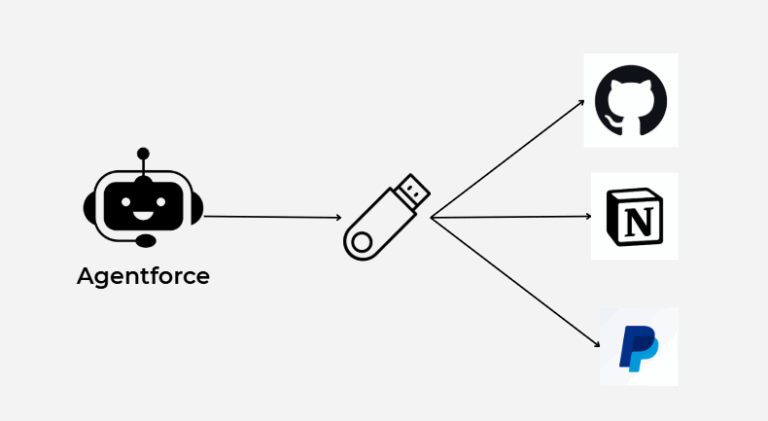
The Silent Struggle of Brilliant, Isolated AI Agents
The age of agentic AI is upon us. Across industries, autonomous agents are being developed with the promise of transforming productivity, handling complex tasks, and automating workflows with unprecedented intelligence. We have brilliant AI agents capable of reasoning, planning, and executing. Yet, for all their individual brilliance, they have been struggling in silence. The primary blocker to scaling agentic AI to its full enterprise potential hasn’t been the intelligence of the models themselves, but a far more mundane, yet critical, challenge: the plumbing.
With the emergence of solutions like Agentforce 3, we are seeing advancements that address these integration challenges head-on.
Until now, the world of AI agents has been a landscape of digital islands. Each agent, often built with a different framework or by a different vendor, speaks its own language. Connecting an agent to a new tool—a database, a CRM, a payment API, a file system—has required custom, point-to-point integrations. This has led to a state of “tool fragmentation” and “resource fragmentation,” where every new connection is a brittle, bespoke piece of code, creating a mountain of technical debt and making scalable, enterprise-wide deployment a near impossibility. The promise of an autonomous digital workforce has been hobbled by the lack of a common language for tools.
Agentforce 3 exemplifies this shift, bringing forth a standardized approach to AI integration.
This is a classic technology adoption pattern: the application’s potential outpaces the infrastructure’s capability. We’ve reached an inflection point where the most significant gains will come not from marginally better AI models, but from solving this fundamental integration problem. Enter the Model Context Protocol (MCP), an open standard poised to become the universal language for agent-tool interaction. It’s best understood through a simple yet powerful analogy: MCP is the USB-C for AI. Just as USB-C created a single, standardized port to connect a universe of peripherals, MCP provides a universal plug for AI agents to securely and seamlessly connect to any tool or data source.
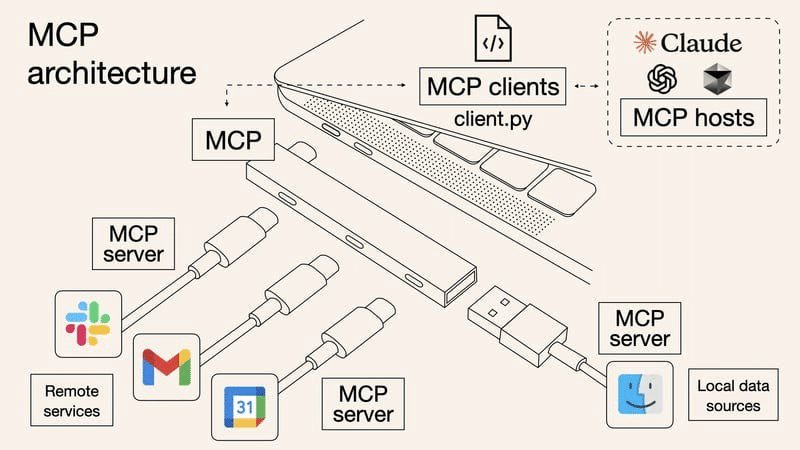
The MCP architecture visualized. An AI ‘Host’ (the brain, like Claude or OpenAI) uses a standardized protocol (the hub) to connect to various external ‘Servers’ (the tools and data), creating a ‘plug-and-play’ ecosystem for AI capabilities. Adapted from visualization featured in “¿Qué es el MCP y para qué sirve?” by Germán Huertas Piquero: https://www.linkedin.com/pulse/qu%C3%A9-es-el-mcp-y-para-sirve-germ%C3%A1n-huertas-piquero-vbbyf/
Deconstructing the Magic: A Deep Dive into the Model Context Protocol (MCP)
To understand the revolution MCP represents, we must look beyond the analogy and into its architecture. MCP is an open protocol, heavily inspired by the success of the Language Server Protocol (LSP) which standardized how development tools support various programming languages. In the same way, MCP standardizes how AI applications integrate with the vast ecosystem of external tools and data they need to be effective.
At its core, MCP operates on a client-host-server architecture built on the well-established JSON-RPC 2.0 standard.
- The Host is the main AI application, such as Salesforce’s Agentforce or Anthropic’s Claude Desktop. It acts as the orchestrator, managing connections to various servers and enforcing security policies.
- The MCP Server is a lightweight wrapper around a specific capability. Instead of a monolithic integration, you can have a dedicated MCP server for your PayPal API, another for your Box file system, and another for a custom database.
- The Client is the connector within the host that maintains the stateful connection to a server.
An MCP server can offer three fundamental primitives to an agent:
- Tools: These are executable functions that the AI model can discover and invoke to perform actions, like
process_paymentorretrieve_document. - Resources: This is contextual data that the agent can access to inform its decisions, such as a product catalog, a user’s purchase history, or the contents of a specific file.
- Prompts: These are pre-defined, reusable templates or workflows that guide the agent in performing common or recurring tasks.
Crucially, the protocol is designed with enterprise-grade security at its heart. It operates on a principle of explicit user consent and control. The Host application is responsible for managing all authorization and ensuring that the user approves any data access or tool execution. This design provides a robust framework for data privacy and tool safety, directly addressing a key enterprise concern
The Critical Difference: MCP vs. Traditional APIs
The true paradigm shift of MCP becomes clear when contrasted with traditional API integrations. This distinction is the difference between giving an employee a single, specific instruction versus giving them a complete toolbox and the autonomy to solve a problem.
A traditional API integration is deterministic and developer-defined. A developer writes explicit code to call a specific API endpoint with a pre-defined set of parameters. The agent’s capabilities are fixed and hard-coded. If you want the agent to do something new, a developer has to write new code.
An MCP-based integration is autonomous and model-driven. The developer doesn’t write code for every single action. Instead, they expose a set of tools to the agent via an MCP server. The Large Language Model (LLM) at the agent’s core then reasons about the user’s request, autonomously selects the appropriate tool (or sequence of tools) from its available “toolbox,” and executes it to achieve the goal. This shifts the burden of complex workflow orchestration from the developer to the model’s reasoning engine.
How Salesforce Enables the MCP-Powered Enterprise
Salesforce understands that for enterprises to adopt MCP, they need a clear on-ramp. An open standard is only as powerful as the tools available to implement it. This is why the roles of MuleSoft and Heroku are central to Salesforce’s strategy.
- MuleSoft: The Bridge from Legacy to Future. Enterprises have thousands of existing APIs that lock away valuable data and business logic. MuleSoft’s new MCP connectors act as an instant translation layer, allowing companies to wrap any existing API and expose it as a secure, governed, and agent-ready MCP server. This provides a seamless bridge from the old world of bespoke APIs to the new world of standardized agentic tools.
- Heroku: The Factory for New Tools. When a company needs a new, custom capability—perhaps a computationally intensive data analysis task or a unique Python-based utility—Heroku provides the ideal platform. Developers can build and deploy these custom tools as secure, scalable MCP servers that operate entirely within the Salesforce trust boundary, ready to be consumed by Agentforce.
Together, MuleSoft and Heroku provide a comprehensive solution for enterprises to “MCP-ify” their entire landscape of tools, whether they are converting the old or building the new.
Salesforce Agentforce 3: Putting MCP to Work in the Enterprise
With the launch of Agentforce 3, Salesforce is not merely supporting MCP; it is building an entire enterprise-grade ecosystem around it, designed to deliver on the promise of interoperability with the trust, governance, and control that businesses demand.
The platform’s approach to Agentforce Interoperability is multi-layered. At its foundation, Agentforce 3 includes native MCP client support, which means any Agentforce agent can connect to and use any MCP-compliant server without requiring a single line of custom code. This is the technical underpinning that makes the “USB-C for AI” vision a reality within the Salesforce ecosystem.
However, open standards can feel like the “wild west” for enterprises concerned about security and reliability. This is where Salesforce’s strategy becomes particularly insightful. It addresses this challenge with two key innovations:
- The AgentExchange: This is Salesforce’s marketplace for AI actions and tools, acting as a trusted “App Store for Agents.” Through the AgentExchange, customers can discover and deploy pre-vetted, certified MCP servers from a rapidly growing ecosystem of over 30 launch partners. This solves the discovery problem and provides a crucial layer of trust. When a business deploys an MCP server from the AgentExchange, they do so with the confidence that it has been validated by Salesforce for security and compatibility.
- The AI Agent Gateway: This is the critical governance layer that provides centralized control. Engineered by MuleSoft, the gateway acts as a unified registry where administrators can manage all MCP servers connected to their organization. They can create allow-lists, enforce security policies, control which agents can access which tools, and monitor all activity. This is the enterprise-grade “bouncer at the door,” ensuring that the power of open interoperability is wielded safely and according to corporate policy.
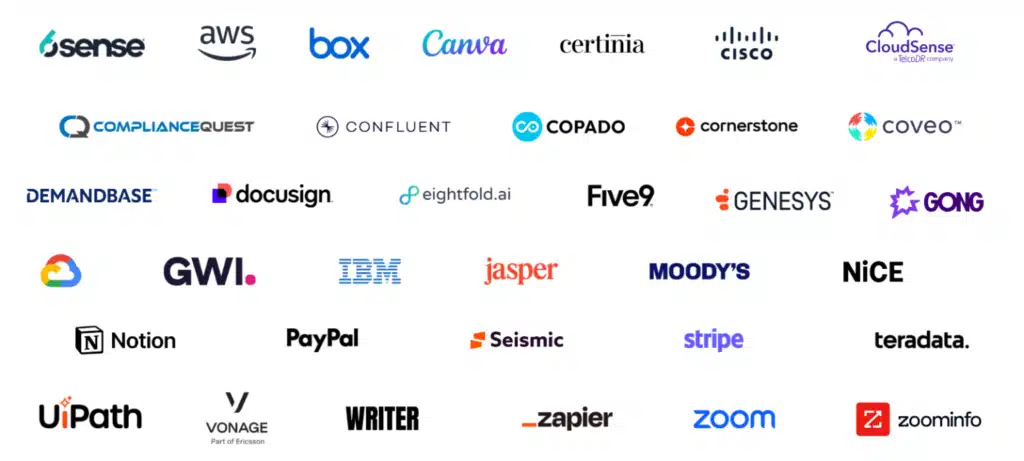
Agentforce MCP Partners. Image from AgentExchange, featuring Agentforce MCP Partners. Accessed from https://appexchange.salesforce.com/collections/agentforce-mcp.
This strategy allows Salesforce to embrace the innovation of an open standard while providing the walled garden of trust that enterprises require. The company isn’t trying to own the MCP standard; it is positioning itself as the most trusted platform for orchestrating it.
Imagine an Agentforce agent tasked with onboarding a new client. Through MCP, it could:
- Securely connect to Box to retrieve the latest signed NDA, summarize its key terms, and post an update to a Slack channel.
- Interact with PayPal or Stripe to automatically generate the first invoice and process a payment.
- Call upon WRITER‘s enterprise-grade AI agents to generate compliant, on-brand welcome materials.
- Leverage AWS services to query vast repositories of unstructured data relevant to the new client.
Each of these actions happens through a standardized, secure protocol, orchestrated by Agentforce but powered by a diverse ecosystem of best-in-class partners.
To see these concepts of interoperability and governance come to life, the team at Salesforce has put together a powerful demo. The video below provides a practical look at how an admin uses Agentforce Builder to seamlessly connect to a PayPal MCP Server via the AgentExchange—no custom integration needed. It’s a perfect, real-world example of MCP enabling secure, multi-system orchestration, all wrapped in the enterprise-grade trust layer that Agentforce provides.
Beyond Integration: The Pillars of an Enterprise-Grade Agent Platform
Agentforce 3’s vision extends beyond just tool integration. Interoperability is one of three foundational pillars designed to create a complete, enterprise-ready digital labor platform.
The second pillar is observability, delivered through the new Agentforce Command Center. This is a complete monitoring solution built to track, measure, and optimize the performance of AI agents. The language used to describe its capabilities—tracking agent adoption, success rates, cost, and health—is telling. It’s the language of human resource management, not just software monitoring. This deliberately positions Agentforce as a platform for managing a new class of employee: the digital worker. Business leaders can now measure the ROI of their AI workforce with the same rigor they apply to their human teams, making the value of AI concrete and manageable.
The third pillar is the enhanced Atlas Architecture, the “brain” behind Agentforce. This has been re-engineered for unmatched enterprise readiness, delivering 50% lower latency, greater accuracy through web search grounding and inline citations, and enhanced resiliency with automatic model failover. Furthermore, it expands LLM choice, adding support for models from Anthropic and Google, ensuring customers can use the best model for the job while staying within the Salesforce trust boundary.
Conclusion: From Custom Code to Composable AI
The introduction of the Model Context Protocol, championed and operationalized by platforms like Salesforce Agentforce 3, marks a pivotal moment in the evolution of artificial intelligence. We are moving away from an era of building brittle, monolithic AI applications with custom code and entering an era of composable AI.
But giving agents their tools is only the first step. What happens when these newly empowered, specialized agents need to collaborate with each other? This is something we’ve already covered in our blog post, A2A and the Future of Collaborative AI Ecosystems.
References:
Anthropic. (n.d.). Model Context Protocol (MCP). Anthropic API. Retrieved July 9, 2025, from https://modelcontextprotocol.io/introduction
Damco Solutions. (2025). Salesforce Agentforce 3: What’s new for enterprises? Damco. Retrieved July 9, 2025, from https://www.damcogroup.com/blogs/agentforce-3-what-do-we-know-so-far
Everest Group. (2025). Salesforce’s Agentforce 3: A bold bet on enterprise-grade AI agent management. Retrieved July 9, 2025, from https://www.everestgrp.com/blog/salesforces-agentforce-3-a-bold-bet-on-enterprise-grade-ai-agent-management-blog.html
IBM Technology. (2025). MCP vs API: Simplifying AI agent integration with external data [Video]. YouTube. https://www.youtube.com/watch?v=7j1t3UZA1TY
Koul, N. (2025). The model context protocol (MCP) — A complete tutorial. Medium. Retrieved July 9, 2025, from https://medium.com/@nimritakoul01/the-model-context-protocol-mcp-a-complete-tutorial-a3abe8a7f4ef
Salesforce. (2025). Salesforce announces Agentforce 3. Salesforce News. https://www.salesforce.com/news/press-releases/2025/06/23/agentforce-3-announcement/
Tinybird. (2025). MCP vs APIs: When to use which for AI agent development. Retrieved July 9, 2025, from https://www.tinybird.co/blog-posts/mcp-vs-apis-when-to-use-which-for-ai-agent-development